


Related Posts
Measuring the Proteins That Matter Most with SomaSeq Discovery
Methylation Sequencing Series, Part 3: How Long‑Read Platforms Reveal Methylation Without Chemical Conversion
Methylation Sequencing Series, Part 2: Bisulfite Sequencing as the Historical Gold Standard
Methylation Sequencing Series, Part 1: What Is DNA Methylation and Why Should You Care?
DNA Methylation Detection: Accuracy, Coverage and Resolution – PacBio vs. Oxford Nanopore
In our previous post, we explored how PacBio and Oxford Nanopore sequencing captures DNA methylation information using fundamentally different approaches. But methylation detection is only as good as the context that comes with it.
The critical question is: How well can each long-read sequencing platform measure methylation across the genome? Can these detection patterns answer my research goals?
When trying to determine the best approach for your methylation project, three factors are particularly important: accuracy, coverage, and resolution.
Head-to-Head: What the Data Shows
- PacBio HiFi: High-Confidence Methylation Maps
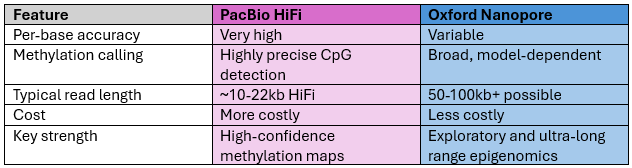
PacBio HiFi sequencing combines long reads with exceptionally high accuracy calls as a product of consensus sequencing. While PacBio long reads max out around 20kb, high confidence methylation information is captured for each position along that read, just waiting for the proper analysis to interpret methylation signatures. This makes PacBio data particularly well suited for applications where confidence in individual bases and methylation calls is critical both per base and for long range correlation studies.
Key strengths of PacBio Methylation include:
- Per-base accuracy: Very high with HiFi reads
- Methylation calling: Highly precise for CpG methylation
- Read length: Long, with approximately 10–22 kb HiFi reads typical for many applications
- Methylation resolution: High-confidence, base-level characterization
- Genome-wide profiling: Well suited for generating detailed methylation maps
While fragment size is limited per read to get highly accurate consensus, the result is a platform that excels when the goal is to create a high-confidence methylation map with accurate sequence context.
- Oxford Nanopore: Broad and Ultra-Long-Range Epigenomics
Oxford Nanopore sequencing infers methylation information directly from changes in the electrical signal as DNA passes through the nanopores. Combined with Oxford Nanopore limitless read lengths, methylation detection can be integrated into real-time sequencing across the entire genome. With reads of 50kb, 100kb, or longer possible on this platform, this creates opportunities to study methylation patterns across very large genomic regions in a single read.
Key strengths include:
- Per-base accuracy: Variable and dependent on sequencing chemistry, basecalling, and analysis methods
- Methylation calling: Broad and highly dependent on the computational model used
- Read length: Ultra-long, with 50–100 kb+ reads possible
- Methylation resolution: Can support single-base modification detection, depending on the modification and model
This makes ONT particularly attractive for exploratory epigenomics and studies where long-range genomic context is the priority, thought the tradeoff for this range is a slight decrease in per-base accuracy.
Choosing the Right Platform for Your Methylation Goals
In the end, there is no single “best” platform for every methylation experiment. Both platforms are moving methylation analysis beyond short genomic windows and toward a more integrated view of sequence, methylation, haplotype, and genomic structure on the same DNA molecule. The right choice depends on the biological question.
If your priority is high-confidence sequence accuracy and precise CpG methylation maps, PacBio HiFi offers a compelling combination of consensus accuracy, long reads, and methylation detection.
If your priority is ultra-long-range genomic context, real-time sequencing, or broad exploration of DNA modifications, ONT provides capabilities that can be difficult to replicate with other technologies.
Ready to power your next epigenomics discovery?
Add these foundational services to your cart to get started:
Related Posts
Measuring the Proteins That Matter Most with SomaSeq Discovery
Methylation Sequencing Series, Part 3: How Long‑Read Platforms Reveal Methylation Without Chemical Conversion
Methylation Sequencing Series, Part 2: Bisulfite Sequencing as the Historical Gold Standard
Methylation Sequencing Series, Part 1: What Is DNA Methylation and Why Should You Care?