



Probe Free rRNA Depletion Using ZymoSeq RiboFree Total RNA Library Kit
Question
Dear Gene, my lab is attempting metatranscriptomics on a wastewater sample, but traditional methods always result in us sequencing mostly ribosomal RNA content. Is there any way to easily overcome this challenge?
Answer
Great question! Let’s start by unpacking why traditional RNAseq library preparation methods may struggle to effectively deplete the ribosomal RNA (rRNA) from your wastewater samples and other mixed sample types.
In a cell, rRNA makes up anywhere from 80-90% of the total RNA. While rRNA is biologically relevant, it is often not the focus of various RNAseq applications. Many RNAseq library preparation methods incorporate a rRNA removal step in order to efficiently sequence the RNA of interest.
The most common ribosomal RNA depletion approaches incorporated into many commercial kits/protocols are:
- Probe-based rRNA removal; probes that are specific to an organism’s rRNA sequences will bind the rRNA to pull down the bound probe and/or degrade the rRNA sequence, removing them from the pool of transcripts for sequencing.
- Poly(A) Selection; oligo-dT beads are used to selectively capture messenger RNA (mRNA) molecules based on the presence of polyadenylated tails. As such, this method is only compatible with polyA tailed RNA and therefore is not compatible with all sample types. For microbes, polyA tails may be exogenously added to microbial transcripts, but this process is heavily biased and inefficient at scale.
For mixed sample types where non-polyadenylated mRNA transcripts from bacteria are being studied, researchers have traditionally been forced into the use of probe-based rRNA removal systems to limit mRNA selection bias. This produces datasets heavily impacted by rRNA carryover caused by common challenges and issues for mixed sample types:
- Probes are based on a pre-set, finite list of rRNA sequences, typically corresponding to a small subset of common bacterial species.
- The bacterial constituents of mixed sample types are often unknown.
These challenges can hinder metatranscriptomics projects, requiring the researcher to sequence through contaminating rRNA at very high sequencing depths.
To overcome these limitations, SeqCenter has adopted the ZymoSeq RiboFree Total RNA Library Kit. This kit features a novel probe-free rRNA depletion technology, RiboFree Universal Depletion, that is compatible with total RNA from any organism. This technology uses the input RNA as templates to drive the enzymatic removal of the reverse transcribed cDNA from the overly abundant ribosomal RNA sequences, thus eliminating the need to select, design or add organism-specific probes.
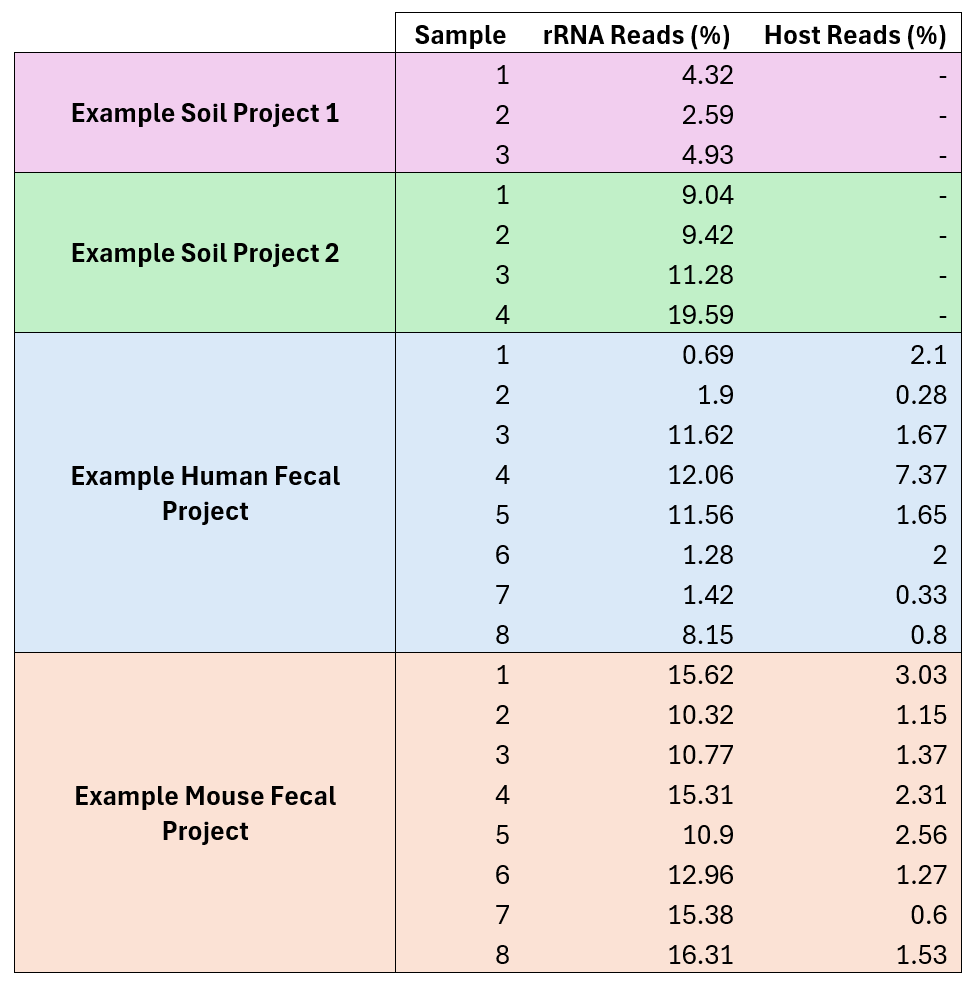
While not limited to just metatranscriptomes, this kit is an obvious candidate to efficiently generate sequencing libraries from mixed sample types such as stool and soil. Zymo Research has validated that this kit reliably produces <20% reads corresponding to rRNA with minimal host contamination for both stool and soil sample types as shown in the table below:
The Table 1 below shows that the kit is effective in limiting carry over of rRNA and host RNA into the final bulk RNA sequencing data, allocating nearly 90% of the data for metatranscriptomic functional analyses.
Table 1. Stool/Soil rRNA Depletion Efficiency using ZymoSeq RiboFree Total RNA Library Kit.
References:
1: Zymo-Seq RiboFree Total RNA Library Kit. c2026. Zymo Research. https://www.zymoresearch.com/products/zymo-seq-ribofree-total-rna-library-kit?srsltid=AfmBOor2ZOrfxVL_uovDY_IS3DxPp-cXWibPiALdotMkJbS8dngIRSw6